


Table of Contents
- What Makes the Best Custom Birthstone Rings for Family
- Custom Family Birthstone Rings: Stone Count and Layout Options
- The Six Stone Mother's Ring: Design and Setting Choices
- A Birthstone Ring With Children's Names: Engraving and Personalization
- Choosing a Family Birthstone Ring in Gold: Metals and Durability
- Sizing, Resizing, and Care for a Ring Worn Every Day
- What to Check Before You Order
- Frequently Asked Questions
Last Updated: October 20, 2026
What Makes the Best Custom Birthstone Rings for Family
The best custom birthstone rings for family get three things right: stone count that matches your family, a metal that survives daily wear, and a setting that keeps each gemstone secure. This guide from Lynrix.com breaks down the decisions that matter before you order.
Most shoppers start with the number of children and work outward. That is the wrong order. Start with how often the ring will be worn, then pick the metal, then the stones.
Selection Criteria That Actually Matter
Five factors separate a ring that lasts from one that disappoints:
- Stone count and layout that fits the family without crowding the band
- Metal durability matched to daily wear, not just personal taste
- Stone type (natural, simulated, or accent) and how each holds up over years
- Setting security for raised or prong-set stones
- Sizing and resizing policy before you commit
A common mistake is choosing the most ornate design first and fitting the family into it later. Work the other way around. The Gemological Institute of America's guide to colored stone jewelry is a useful primer on how gemstones are graded and described, which helps you read a product listing without guessing.
Custom Family Birthstone Rings: Stone Count and Layout Options
Custom family birthstone rings typically run from one to six stones, with two to six covering most families. The count drives band width, setting style, and how the ring sits on the finger.
Layout choices fall into three broad patterns:
- Linear row: stones set side by side along the band, best for three to five stones
- Cluster: stones grouped around a center point, good for four to six
- Graduated: larger center stone with smaller stones flanking it, which keeps a six-stone ring from looking heavy
Families with more than six members usually split across two rings or add a second piece, such as a pendant. Squeezing seven stones onto one band forces smaller gems and thinner settings.
The Six Stone Mother's Ring: Design and Setting Choices
A six stone mother's ring is the hardest configuration to get right. Six stones on one band forces trade-offs between stone size, setting security, and comfort. Below is an editorial comparison of six common six-stone ring styles.
How We Evaluated These Six Styles
We assessed each style against five criteria:
- Stone size retention: How large each birthstone can remain (typically 3mm to 5mm) without crowding.
- Setting security: Whether stones are prong-set, bezel-set, or channel-set, and how exposed they are to snagging or loss.
- Comfort: Profile height, underside smoothness, and band width relative to finger size.
- Resizing potential: Whether the design can be sized up or down without rebuilding the setting.
- Value: Relative cost per stone given metal weight and labor.
Six-Stone Ring Styles Compared
1. Shared-Prong Linear Row Stones sit side by side, sharing prongs between neighbors, keeping the profile low and the look continuous.
2. Graduated Prong Set A larger center stone (often 5mm) with progressively smaller stones flanking it.
3. Bezel-Set Cluster Each stone is wrapped in metal, grouped in a cluster.
4. Channel-Set Row Stones are set between two rails of metal.
**5.
**6.
The Underside Matters More Than the Top
What most guides miss is the underside of the ring. Six settings mean six chances for a prong to snag. Ask how the stones are secured from below, and check whether the band is thick enough to hold the settings without flexing.
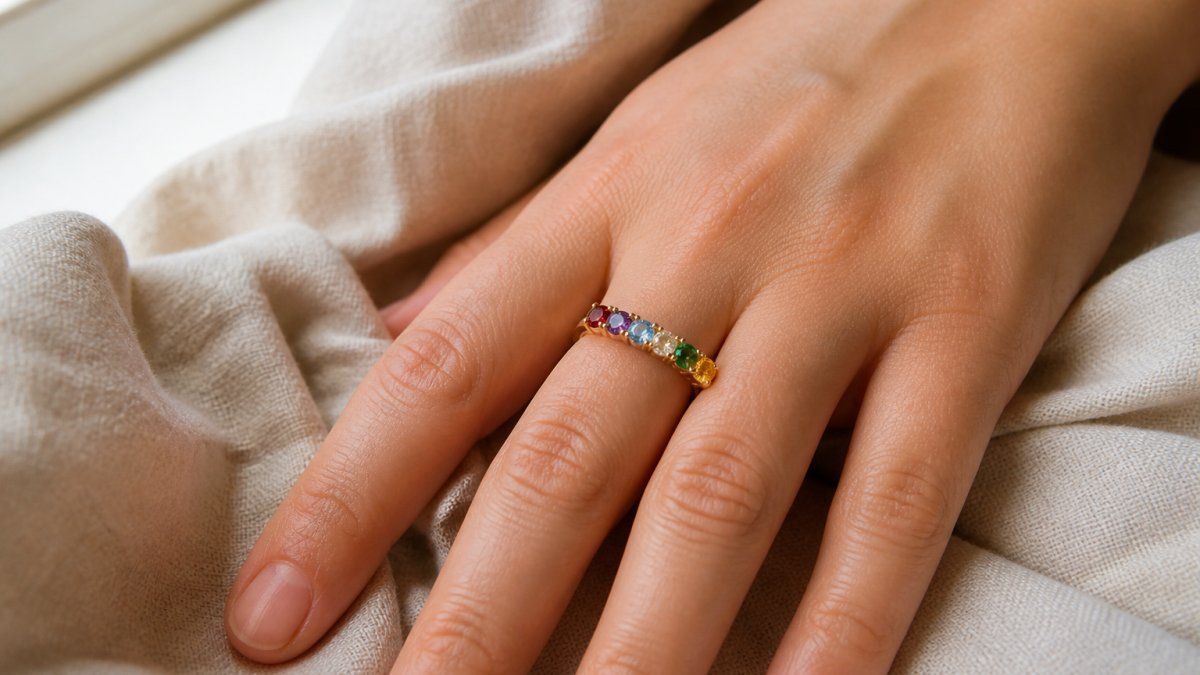
A Birthstone Ring With Children's Names: Engraving and Personalization
A birthstone ring with children's names pairs each stone with an engraved name, usually inside the band or on a small plaque. Engraving space is limited, so plan the names before you order.
Practical limits to know:
- Long names may need to be shortened or placed on the inner band
- More than four names usually requires a wider band or a separate engraving plate
- Engraving depth affects legibility over years of wear
Ask to see a proof or preview before production; if no preview is offered, look elsewhere. Check the seller's policy on engraving errors, since personalized items are often excluded from standard returns.
Choosing a Family Birthstone Ring in Gold: Metals and Durability
A family birthstone ring in gold comes in yellow, white, and rose varieties, and the alloy matters as much as the color. Higher-karat gold is softer; lower-karat gold is harder and better at holding settings.
Metal options you will see:
| Metal | Durability | Best For | Watch Out For |
|---|---|---|---|
| Sterling silver | Moderate | Lower-budget, occasional wear | Tarnishes; softer prongs |
| 10k gold | High | Daily wear, active hands | Less rich color |
| 14k gold | High | Most everyday rings | Higher cost |
| White gold | High | Modern look | Needs replating over time |
| Platinum | Very high | Heirloom pieces | Heaviest and costliest |
Gold-plated bands cost less but wear through at contact points. For a ring meant to last decades, solid gold or platinum is the safer call. The Federal Trade Commission's guidance on jewelry marketing claims explains how metal and gemstone descriptions must be disclosed, which helps you spot vague listings.
Natural, Simulated, and Accent Stones
Natural birthstones carry the highest value and the most variation in color. Simulated stones cost less and offer consistent color, which suits matching multiple stones. Accent stones, often small diamonds, add sparkle without changing the birthstone count.
Ask which category each stone falls into, and get it in writing. A listing that says "birthstone" without specifying natural or simulated is telling you nothing.
Sizing, Resizing, and Care for a Ring Worn Every Day
Sizing and resizing are the most common post-purchase regrets for custom birthstone rings. A ring that fits poorly gets worn less, and a ring that cannot be resized becomes a costly mistake.
Getting the Size Right the First Time
Professional sizing is essential, but timing and method matter. Fingers swell throughout the day and in warm weather. Get sized late in the afternoon, when fingers are at their largest. Measure the specific finger the ring will occupy.
Wide bands (6mm and wider) fit tighter than narrow bands because they cover more of the finger. For a six-stone ring, which often has a wider band, size up by a quarter to a half size.
Which Settings Can Be Resized
Resizing a custom birthstone ring depends on the setting type:
- Plain prong settings: Usually resizable up or down by one to two sizes. Beyond that, the prongs may need re-tipping.
- Bezel and cluster settings: Difficult to resize because the metal is rigid and stones are closely set. Many jewelers will not resize a cluster without rebuilding the setting.
- Channel settings: The least resizable. Changing the size often requires replacing the entire channel and resetting all stones.
- Eternity-style bands: Cannot be resized without adding or removing stones, which changes the design.
Ask the seller for the resizing policy in writing before purchase. Some custom rings are excluded from resizing altogether. If the ring cannot be resized, consider a sizing bead or a loose-fit guard as a backup.
Gemstone Durability and Care by Stone Type
Birthstones vary widely in hardness, which determines how well a stone survives daily wear. On the Mohs scale, harder stones resist scratching and softer stones require protective settings.
- Hard stones (Mohs 8-10): Diamond, sapphire, ruby, and spinel are suitable for daily wear in almost any setting.
- Medium stones (Mohs 6-7): Amethyst, citrine, and quartz are fine for occasional wear but benefit from bezel settings for daily wear.
- Soft stones (Mohs 5 and below): Opal, pearl, turquoise, and moonstone scratch easily and should be set in bezels or worn occasionally. Pearl and opal are also sensitive to chemicals and heat.
A common mistake is choosing a soft stone for a ring worn every day. If the birthstone is soft, consider a bezel setting or a ring worn on special occasions.
Cleaning and Maintenance
- Clean with warm water and mild dish soap, then dry fully with a soft cloth.
- Avoid ultrasonic cleaners for opal, pearl, turquoise, and other porous stones; the vibrations can cause damage.
- Remove the ring for cleaning, gardening, and gym sessions.
- Store separately to avoid scratching softer stones.
- Have prongs checked annually by a jeweler; a loose prong is the most common cause of stone loss.
What to Check Before You Order
Run this checklist before checkout:
- Stone count matches the family members you are honoring
- Metal and karat are stated explicitly
- Each stone is labeled natural or simulated
- Engraving names and spelling are confirmed with a preview
- Ring size is measured professionally
- Resizing, return, and warranty terms are clear
- Shipping timeline fits your occasion date
At Lynrix.com, our personalized jewelry and keepsake collection is built around exactly this kind of milestone gifting. Ordering early matters most for engraved pieces, since personalization adds production time.
A family birthstone ring only works when the details line up: the right stone count, a metal that holds up, and personalization you have seen before production. At Lynrix.com, we offer personalized jewelry and lifestyle gifts designed for exactly these moments, with options to customize stones, metals, and engraving to fit your family.
Frequently Asked Questions
How many birthstones can you put in a family ring?
Most custom family birthstone rings hold one to six stones, with two to six being the most common range for a mother's ring. Six stones covers a couple plus four children, or a grandparent with five grandchildren. Beyond six, the stones get smaller and the band gets wider, which changes how the ring wears. If your family is larger, ask whether the design can add accent stones, split stones across a wider band, or use a stacked style instead of one row.
What metal is best for a birthstone ring worn every day?
For daily wear, 14k gold and platinum hold up best. Both resist scratching and bending better than 10k gold or sterling silver, and platinum keeps its structural strength even as it ages. Sterling silver is the most affordable option but softens and tarnishes over time, so it suits occasional wear. White gold, yellow gold, and platinum all work well with colored gemstones. Check the band thickness too, since a thin band wears through faster regardless of metal.
Can a family birthstone ring be resized?
Resizing depends on the design. Plain bands in gold or platinum can usually be adjusted by a jeweler, though rings with stones set all the way around the band are harder to resize without disrupting the setting. Ask before you order whether the ring can go up or down a size, and how far. If the recipient's size may change, choose a style with a solid back or a sizing bead rather than a full eternity setting.
How do you care for a custom birthstone ring?
Clean the ring with warm water, mild dish soap, and a soft brush, then dry it with a lint-free cloth. Avoid ultrasonic cleaners on softer stones like opal, pearl, and emerald, since vibration and heat can damage them. Take the ring off before swimming, cleaning with harsh chemicals, or lifting weights. Store it separately from harder pieces so diamonds and sapphires do not scratch the softer birthstones. Have prongs checked once a year if the ring is worn daily.


