


Table of Contents
- Hallmarks, Metal Stamps, and What They Actually Tell You
- Best Metals for Everyday Personalized Jewelry
- How to Identify Real Gold Jewelry
- Craftsmanship, Solder Joints, and Setting Security
- Clasp Integrity, Weight, and Finish Quality
- How to Care for Custom Jewelry and Spot Wear Early
- Frequently Asked Questions
Last Updated: September 16, 2026
Hallmarks, Metal Stamps, and What They Actually Tell You
A metal stamp is a small mark inside a ring band or on a necklace clasp that identifies the metal's purity and composition. Learning how to tell if personalized jewelry is high quality starts here, because the stamp is the one claim a maker puts in writing on the piece itself. At Lynrix.com, we tell shoppers to check the clasp first, since that is where stamps hide on custom necklaces.
Best Metals for Everyday Personalized Jewelry
The best metal for daily wear matches how often the piece gets worn and what it touches. Someone who never removes a necklace needs tarnish resistance and skin-friendly composition; someone wearing a piece twice a month can prioritize finish and price.
- Stainless steel: Durable, resists tarnish, and holds up to daily wear and hand washing. The practical default for everyday custom jewelry.
- Sterling silver: A precious metal with a bright finish, but it tarnishes over time and needs periodic polishing. Best for occasional wear.
- Gold finish over steel: The warm look of gold at a lower cost. The finish can wear at high-friction points like the clasp over time.
Stainless Steel, Gold Finish, and Sterling Silver Compared
| Metal | Everyday Durability | Tarnish Resistance | Maintenance |
|---|---|---|---|
| Stainless steel | High | High | Minimal |
| Sterling silver | Moderate | Low | Regular polishing |
| Gold finish | Moderate | High until worn | Gentle cleaning |
A common mistake is buying sterling silver for a piece someone will shower and swim in. It tarnishes faster than expected, a material choice problem, not a quality problem.
How to Identify Real Gold Jewelry
Real gold jewelry carries a karat stamp, and solid gold is not magnetic, two facts that settle most at-home questions. But "real gold" covers a wide range, and personalized jewelry sellers use the term loosely. Knowing the difference between solid gold, gold-filled, gold vermeil, and gold-plated pieces separates a confident purchase from a gamble.
What the Karat Number Actually Means
A karat mark tells you the proportion of gold in the alloy, not the weight of the piece:
- 24K is pure gold, too soft for everyday jewelry and rarely used in personalized pieces.
- 18K is 75% gold. Common in fine personalized jewelry; warmer color, softer than 14K.
- 14K is 58.3% gold. The most common choice for everyday rings and name necklaces in the U.S. because it balances color, durability, and price.
- 10K is 41.7% gold. The minimum karat that can legally be stamped and sold as gold in the U.S. Harder and more scratch-resistant, but paler in color.
Gold-Plated vs. Gold-Filled vs. Vermeil
These three terms get used interchangeably in listings, but they describe very different products:
- Gold-plated: A microscopic layer of gold electroplated over a base metal like brass or steel, measured in microns (µm). Under 0.5 µm is decorative only and wears through at friction points within months. 1-2.5 µm is mid-range and can last a year or more with careful wear. Above 2.5 µm is heavy plating, the closest plated option to long-term durability.
- Gold-filled: A thicker layer of gold (at least 5% of the total weight by U.S. trade standard) mechanically bonded to a base metal. It wears far longer than plating and is often stamped "14K GF" or "1/20 14K."
- Gold vermeil: Sterling silver base with at least 2.5 µm of gold plating, per the FTC's minimum standard. The sterling core makes it a step up from plated brass, but the gold layer is still thin enough to wear at high-friction points.
The Magnet Test and Other At-Home Checks
- Check the stamp first. Look for a karat mark like 10K, 14K, or 18K inside the band or on the clasp, on personalized pieces, often the clasp tag rather than the pendant.
- Run a magnet over the piece. Solid gold, sterling silver, and stainless steel are non-magnetic; if it sticks firmly, the base metal is showing through. A magnet will not catch good plating over a non-magnetic base like brass, so passing does not confirm solid gold.
- Look at the color under bright light. Real gold has a consistent warm tone; plating often looks different at edges and wear points where the base metal shows.
- Weigh it in your hand. Gold feels denser than plated costume jewelry of the same size. A 14K gold name necklace will feel noticeably heavier than a plated steel one of the same dimensions.
- Check for green or black marks on skin. This usually points to a base metal reacting with skin, not to solid gold. Nickel and copper are the most common culprits.
Craftsmanship, Solder Joints, and Setting Security
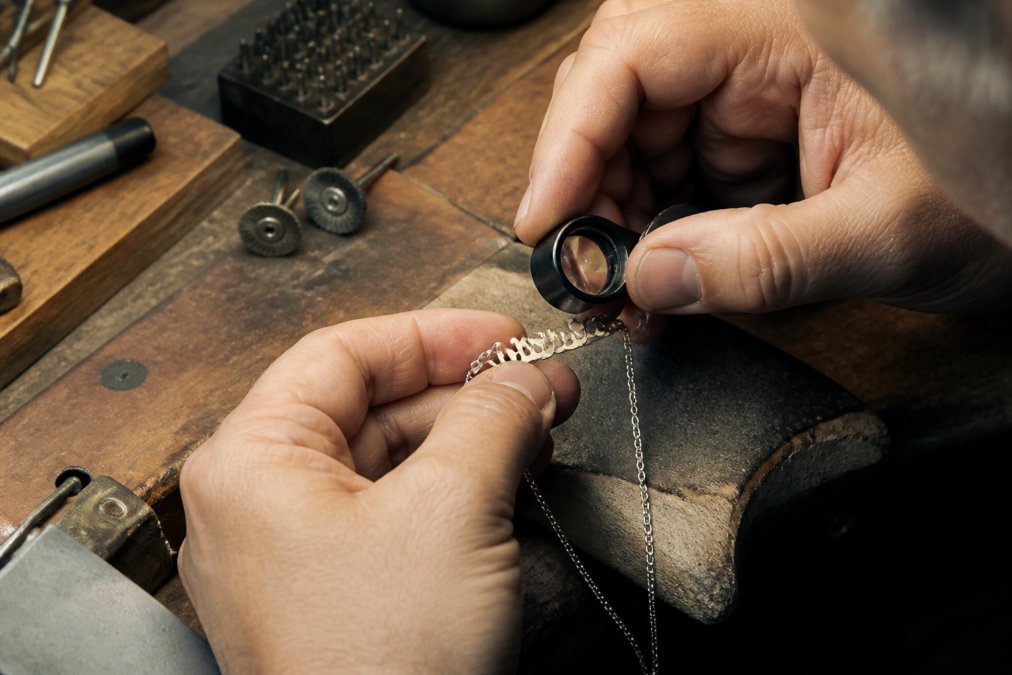
Craftsmanship shows up at the joints and settings, not the front of the pendant. A solder joint is where two metal parts are fused; a sloppy one looks lumpy, discolored, or uneven under close inspection. For name necklaces, check the connection between the script letters and the chain loop first.

Clasp Integrity, Weight, and Finish Quality
A lobster clasp should open smoothly and snap closed with a firm click. If the spring feels weak or the clasp wiggles, the piece will fail at the clasp long before the metal wears out. Weight is the second clue: a piece that feels hollow or flimsy for its size usually has thin fabrication. Finish is the third, run a fingertip along the edges, and burrs or rough spots mean the polishing step was rushed.
Classic Heart Style Name Necklace →
Where Personalized Pieces Actually Fail First
Most custom name necklaces, engraved bracelets, and monogram pendants fail at one of four points, in roughly this order:
- The jump ring connecting the pendant to the chain. On many custom pieces this ring is laser-welded rather than soldered. A laser weld is fast and clean, but an under-powered one leaves a hairline gap that opens with repeated pulling. Inspect it under bright light: a good weld is a continuous seam with no visible line; a weak one shows a faint crack or darker band.
- The chain itself, if it is under 1.2 mm wide. Thin cable chains photograph well, but a 0.8-1.0 mm chain on a pendant weighing more than a few grams will stretch and eventually snap. Practical rule: the chain should hold the pendant's weight without flexing when you dangle the piece by the clasp.
- The clasp spring. A 9 mm lobster clasp is common on custom necklaces and adequate for most pendants, but a 6 mm clasp on a heavier piece is undersized. Open and close it ten times, a quality spring returns to the same tension every time; a cheap one loosens noticeably by the tenth cycle.
- The engraving edges. Deep, even engraving holds its contrast for years. Shallow engraving fills with skin oils and grime, and edges can chip if the engraving was cut after plating rather than before. Run a fingernail across the engraved line: if it catches on a raised burr, the finishing step was skipped.
Plating Thickness and Where It Wears Through
On gold-finish personalized jewelry, the finish is the first thing to go, at predictable spots. Friction and skin contact wear plating fastest at the clasp, jump ring, chain links nearest the neck, and raised engraving edges. A piece plated at 0.5 µm may show base metal at the clasp within months of daily wear; one plated at 2.5 µm or more can hold its color a year or longer under the same conditions.
Weight, Finish, and the Three-Check Order
Weight and finish still matter, but read them through the personalized-jewelry lens:
- Weight: A solid stainless steel or 14K name necklace should feel dense and balanced. If the pendant pulls the chain into a V-shape when you hold it up, the chain is undersized.
- Finish: Check the back of the pendant, not just the front, polishing shortcuts show up there as rough patches, unpolished corners, or a duller tone.
- Edges: On custom-cut shapes (hearts, initials, script letters), the inside curves are the hardest to polish. Run a fingertip along the inner edge of a script letter, a smooth, consistent surface means the piece went through a real finishing step.
How to Care for Custom Jewelry and Spot Wear Early
Custom jewelry needs care matched to its metal, not a universal routine. Stainless steel tolerates warm water and mild soap. Sterling silver needs a soft polishing cloth to slow tarnish. Gold finish should avoid abrasive cleaners, which strip the layer faster. Check engraving at every cleaning: deep, even engraving holds its contrast for years, while shallow engraving fills with grime and fades.

Frequently Asked Questions
What are the signs of high-quality personalized jewelry?
Look for a metal stamp or hallmark on the clasp or pendant, a smooth solder joint with no rough edges, an even finish, and a clasp that opens and closes with resistance. High-quality personalized jewelry also feels solid for its size. On a name necklace like the Classic Style Name Necklace, check that the cursive lettering is evenly cut and that the 9mm lobster clasp lines up cleanly. These details separate fine jewelry from costume jewelry.
How can you tell if gold-plated jewelry is good quality?
Check the plating thickness and the base metal underneath. A polished stainless steel base with an 18K yellow gold finish, like the Classic Vertical Name Necklace, resists tarnish better than brass or copper cores. Look at the edges and the back of the pendant: if the gold color fades to a different tone at the corners, the plating is thin. Ask the seller for the base metal and finish details before you buy.
Does personalized jewelry tarnish easily?
It depends on the metal and how you wear it. Polished stainless steel resists tarnish and oxidization well, which is why it works for daily wear. Gold-plated pieces hold up if the plating is thick and the base metal is stable. Sterling silver tarnishes naturally and needs periodic polishing. Perfume, lotion, sweat, and chlorine speed up tarnish on any metal, so put jewelry on last and take it off before swimming or showering.
What should I look for when buying custom jewelry online?
Ask for close-up photos of the clasp, the solder joint, and the metal stamp before ordering. Confirm the base metal and finish in writing. Check the personalization limits, since a piece capped at 10 characters will space lettering better than an overcrowded design. Read the return policy for personalized items and check the seller's reputation through reviews. A seller who answers these questions directly is usually a safer buy than one who avoids specifics.


