


Last Updated: October 25, 2026
Quick Summary
Choosing heirloom quality blankets means buying a textile built to hold its structure, softness, and meaning for decades instead of a disposable throw that pills and thins after a dozen washes. They cost more once but skip the two-to-three-year replacement cycle, and woven construction can often be re-weaved or darned when damaged.
- Long-staple cotton makes a stronger, smoother yarn that pills less over years of use.
- Check weave consistency, seam and hem construction, fringe, and fiber content before buying.
- Wash only when visibly soiled, using cold water and a mild, pH-neutral detergent.
- Store blankets folded in breathable cotton, away from sunlight, and rotate fold lines.
- Budget throws are typically replaced every two to three years, while heirloom blankets are rarely replaced.
Table of Contents
- Why Heirloom Quality Blankets Outlast Everything Else in the Linen Closet
- The Best Blanket Materials for Warmth, Softness, and Breathability
- Blanket Craftsmanship and Durability: What Separates a Keepsake From a Throwaway
- How to Care for Heirloom Blankets Without Shortening Their Life
- Personalized Family Blankets: Turning a Practical Layer Into a Cherished Keepsake
- The Lifetime Cost of a Cheap Blanket Versus an Heirloom One
- Fiber Sourcing, Allergy Trade-Offs, and Matching a Blanket to Your Climate
- Choosing a Personalized Heirloom Blanket for Your Family
- Frequently Asked Questions
Why Heirloom Quality Blankets Outlast Everything Else in the Linen Closet
Most blankets in a linen closet are disposable. They pill after a dozen washes, thin out at the corners, and get quietly demoted to the dog bed. Heirloom quality blankets are built on a different premise: that a textile can hold its structure, its softness, and its meaning for decades. At Lynrix.com, we see this distinction play out in what customers actually keep.
The difference starts with fiber and construction, not marketing language. A blanket woven from long-staple cotton on a loom behaves differently from a bonded polyester throw, and that difference compounds every year you own it.
consumer textile labeling requirements from the Federal Trade Commission require manufacturers to disclose fiber content and country of origin, which gives you a factual starting point before you buy anything.
Below, we break down what actually separates a blanket you hand down from one you replace.
The Best Blanket Materials for Warmth, Softness, and Breathability
Material choice decides almost everything about how a blanket feels and performs. Wool traps warmth even when damp, cotton breathes and washes well, bamboo drapes softly, and polyester holds color but traps heat. Each fiber carries trade-offs you should match to how you actually use the blanket.
- Wool: Excellent insulation and resilience; crimps back into shape rather than flattening
- Cotton: Breathable, machine washable, and gets softer with age
- Bamboo: Silky drape and good temperature regulation, but less abrasion resistance
- Polyester: Cheap and colorfast, but poor breathability and prone to pilling
A common mistake is buying for the label rather than the use. A heavyweight wool quilt is miserable in a warm bedroom; a lightweight cotton throw is useless on a cold porch.
Blanket Craftsmanship and Durability: What Separates a Keepsake From a Throwaway
Craftsmanship is where durability is actually decided, and it is also where the word "heirloom" gets used most loosely. A blanket earns that label through measurable construction choices, not through a hangtag. Before you buy, you can check most of them yourself in a few minutes.
Weave and quilting density. Hold the blanket up to light. A tight, consistent weave shows an even grid with few gaps; a loose one lets light pour through in patches.
Seams and edge finishing. Turn the blanket over and inspect the back. Reinforced edge binding, either a folded and stitched tape or a woven self-edge, resists fraying far better than a simple serged edge.
Fiber quality inside the construction. Long-staple cotton produces a stronger, smoother yarn than short-staple cotton, which is why it pills less over years of use. Wool with good crimp resilience springs back into shape rather than flattening.
Repairability. Heirloom blankets are built to be mended. Woven construction can often be re-weaved or darned invisibly, and bound edges can be re-taped. Bonded or glued construction usually cannot be repaired at all, which is the quiet reason those blankets end up as dog beds.
The American Cleaning Institute's fabric care guidance is a useful reference for matching wash methods to fiber type so you do not accelerate wear on a well-built blanket.
How to Care for Heirloom Blankets Without Shortening Their Life
Care is the single biggest variable in how long an heirloom blanket lasts. Wash less often than you think, use cold water and a gentle cycle, skip fabric softener, and dry flat or on low. Store folded in breathable cotton rather than sealed plastic, which traps moisture and invites mildew.
- Wash only when visibly soiled, not on a schedule
- Use cold water and a mild, pH-neutral detergent
- Skip fabric softener and dryer sheets entirely
- Air dry flat or tumble on the lowest setting
- Store folded in a cotton bag, away from direct sunlight
- Rotate fold lines every few months to prevent creasing
For readers thinking about long-term gifting and care together, our guide to custom textile gifts for wedding anniversaries covers how to pair a keepsake with the occasion.
Personalized Family Blankets: Turning a Practical Layer Into a Cherished Keepsake
Personalization changes what a blanket is for. A plain cotton throw is a utility object; a woven blanket carrying a name, a date, or a message becomes a record of a relationship. That shift is why personalized family blankets get kept, displayed, and handed down while ordinary throws get used up.
To My Daughter - Heirloom Blanket →
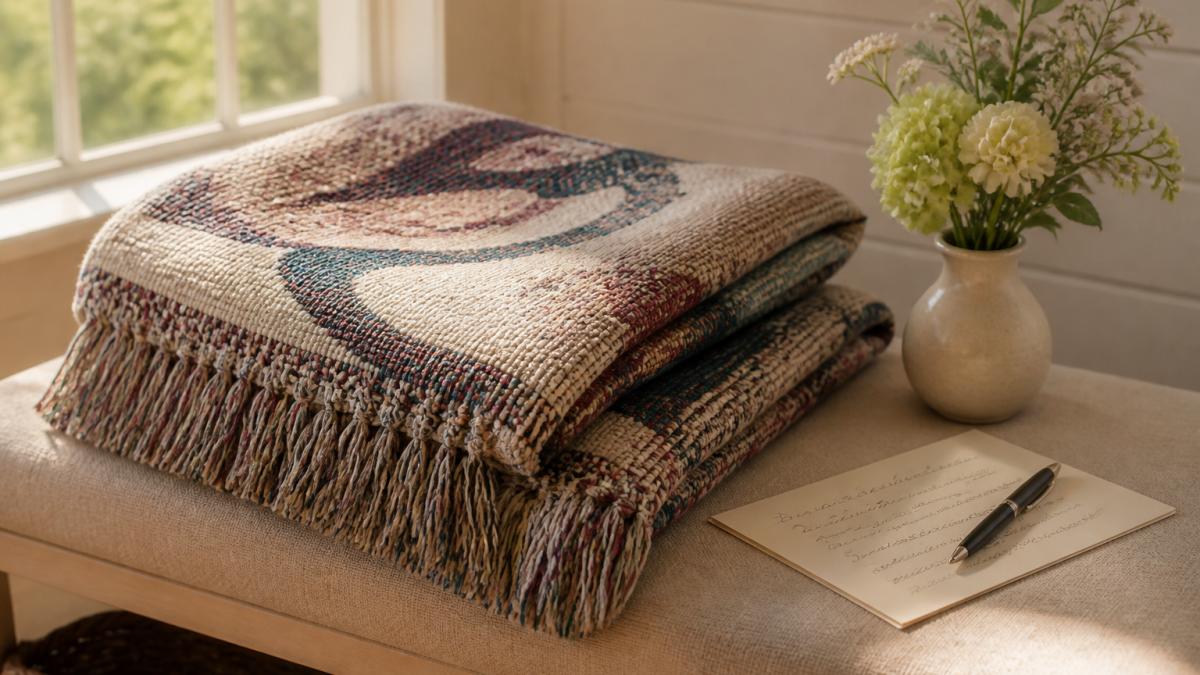
Our To My Daughter heirloom blanket is woven on a loom from 100% cotton yarn with a colorful fringe, so the personalization is part of the fabric rather than printed on top of it. That construction matters: woven-in artwork does not crack, peel, or fade the way surface printing can.

The Lifetime Cost of a Cheap Blanket Versus an Heirloom One
Cheap blankets are not actually cheap. They cost less up front and more over time, because you replace them repeatedly and they never accumulate any value beyond their first season. An heirloom blanket costs more once and then stops costing you anything.
The comparison is easiest to see as a replacement cycle. A budget throw that pills and thins after a couple of seasons typically gets replaced every two to three years. Over a decade, that is three to five purchases, each one landing back at the same starting point.
| Factor | Budget Throw | Heirloom Blanket |
|---|---|---|
| Up-front cost | Low | Higher, one time |
| Replacement cycle | Every few seasons | Rare to none |
| Softness over time | Degrades, pills | Improves with washing |
| Repairability | Usually none | Often re-weavable |
| Sentimental value | None | Grows with the family |
| End of life | Discarded | Passed down |
The repairability line is the one people underestimate. A woven blanket with a pulled thread or a small hole can often be darned or re-weaved, and a bound edge can be re-taped, so a single repair extends its life by years. A bonded or glued throw has no equivalent fix, which means the first failure is the end of its useful life.
There is also a hand-down value that does not show up in a replacement table. If you are weighing the investment against a specific occasion, our guide to buying personalized blankets as anniversary gifts walks through how to choose without overspending.
Fiber Sourcing, Allergy Trade-Offs, and Matching a Blanket to Your Climate
Climate and sensitivity should narrow your shortlist before you look at anything else. Hot, humid bedrooms favor lightweight cotton and bamboo; cold, dry rooms favor wool and denser weaves. Anyone with wool sensitivity should look at cotton first, since cotton is naturally hypoallergenic and does not trap dust the way lofted synthetics can.
Sourcing matters for durability too. Long-staple cotton produces a stronger, smoother yarn than short-staple cotton, which is why it pills less over years of use. Ask where the fiber comes from before you assume two cotton blankets are equivalent.
Choosing a Personalized Heirloom Blanket for Your Family
Choosing well comes down to four decisions: fiber, weight, weave, and message. Get those right and the blanket will outlast the occasion it was bought for.
Start with the recipient's climate and washing habits, then pick a fiber that fits. Choose a weight that matches the season they will actually use it in. Confirm the weave is tight and the edges are bound, not glued. Finally, decide what the personalization should say, because that text is what turns a textile into an heirloom.
For a partner, our To My Wife heirloom blanket is woven from 100% cotton yarn with a colorful fringe. For couples marking a commitment, the Til Death Do Us Part heirloom blanket carries a message built to last as long as the blanket does.


Frequently Asked Questions
What makes a blanket heirloom quality?
Heirloom quality comes down to three things: fiber, construction, and care. Natural fibers such as 100% cotton yarn hold their shape and softness far longer than polyester blends. Tight, even weaving and finished edges, including a secure fringe, prevent the fraying and thinning that end a blanket's life early. Add a design worth keeping and a wash routine that respects the fiber, and you have a blanket that can be handed down rather than replaced.
Are high-quality blankets worth the investment?
A well-made blanket usually costs more up front but spreads that cost over many years of use. A $20 synthetic throw that pills and thins within a couple of seasons gets replaced repeatedly, while a cotton heirloom-quality blanket at $59.99 to $79.99 can stay in daily rotation for a decade or more with basic care. The value calculation changes again when the blanket carries a name, a date, or a message, because it stops being a household item and becomes a keepsake.
What materials are best for an heirloom-quality blanket?
Cotton is the most practical choice for a blanket meant to last and be used. It breathes, regulates temperature, washes well, and softens with age instead of degrading. Wool offers excellent warmth and resilience but needs more careful cleaning. Bamboo and polyester blends feel soft at first, yet many pill or lose loft over time. For a blanket you plan to personalize and pass down, look for 100% cotton yarn and a woven rather than printed construction.
How do you care for a blanket you want to preserve?
Wash sparingly and gently. Use cold water and a mild detergent, skip fabric softener, and dry on low or air-dry flat to protect the weave and fringe. Store the blanket clean and fully dry, folded in a breathable cotton bag rather than a sealed plastic bin, and keep it out of direct sunlight. Rotate where it sits so folds do not set into permanent creases, and repair any loose fringe early before it unravels further.
Can a personalized blanket become a family heirloom?
Yes, and personalization is often what tips a blanket into heirloom territory. A woven blanket carrying a name, a wedding date, or a short message ties the object to a specific person and moment, which is what makes families keep things. Choose a durable base, 100% cotton yarn with a woven design rather than a surface print, so the personalization does not crack or fade away years before the blanket itself wears out.
How can you tell if a blanket is well made?
Check the weave first: hold it up to light and look for even, tight threads with no thin patches. Examine the edges and fringe for secure finishing, since hems and fringe are where cheap blankets fail first. Read the fiber content label and be wary of vague blends. Feel for weight and drape, because a blanket that feels flimsy at the start rarely improves. Finally, look at how the design is applied, since woven patterns outlast printed ones.
The hardest part of buying a blanket as a gift is finding one that will still matter in twenty years. Lynrix.com builds personalized heirloom blankets woven on a loom from 100% cotton yarn with a colorful fringe, designed to be cherished rather than replaced. Browse the collection and choose a message worth handing down. Get started with Lynrix.com and give a blanket your family will still be using decades from now.


