


Last Updated: October 24, 2026
Quick Summary
Lab grown diamonds give custom jewelry more design freedom because they cost less than natural diamonds of comparable size and quality, so savings go into bolder shapes, halo work, or three-stone layouts. They also offer easier matching for repeat orders and documented growth origin, though resale value is thin.
- Lab grown diamonds have the same chemical, physical, and optical properties as mined stones.
- Both lab-grown and natural diamonds score 10 on the Mohs hardness scale.
- Start with cut, then set a clarity floor, then pick carat weight based on the design.
- On a $4,000 budget, a reasonable split might be $2,000 for the stone and $1,000 for the setting.
- Ask the jeweler to show the laser inscription under a loupe before the stone is set.
Table of Contents
- Why Lab Grown Diamonds Fit Custom Jewelry Design
- Lab-Grown Diamond Pros and Cons for Custom Pieces
- Lab-Grown vs. Natural Diamonds: What Actually Differs
- How to Choose a Lab-Grown Diamond for a Custom Setting
- Budgeting a Complete Custom Piece
- Certification, Disclosure, and Aftercare for Custom Orders
- Start Your Custom Design with Lynrix
- Frequently Asked Questions
Why Lab Grown Diamonds Fit Custom Jewelry Design
Lab grown diamonds are real diamonds created in a lab using high-pressure high-temperature (HPHT) or chemical vapor deposition (CVD) methods, with the same chemical, physical, and optical properties as mined stones. That fact reshapes what a custom design can look like.
Custom jewelry has always been a negotiation between vision and budget: a larger center stone usually means a smaller setting budget or a compromise on color grade.
Here is the practical case, in three parts:
- More design freedom. A bigger budget for the center stone means bolder shapes, more halo work, or a three-stone layout that would otherwise be out of reach.
- Consistency on repeat orders. Laboratory-grown stones are produced to spec, so a matched pair for earrings or a second piece years later is far easier to source.
- Full traceability. Growth origin is documented, which matters to buyers who care where a stone came from.
That does not make lab-grown stones right for everyone, but it makes them a strong default for custom work, where the design, not the mining history, is the point. For a broader grounding in design decisions, see the custom gold jewelry buying guide.
Lab-Grown Diamond Pros and Cons for Custom Pieces
The lab-grown diamond pros and cons come down to three wins and three honest limits. Weigh them before you commit, because a custom piece is hard to undo.
Where Lab-Grown Stones Win
Budget goes further into the design. The same money buys a larger center stone or more elaborate setting work, often the difference between a modest solitaire and the design the customer actually sketched.
Consistency is easier to guarantee. When you need two stones that match in cut, color, and size, lab-grown sourcing makes that simpler than hunting natural pairs. Matched earrings and three-stone layouts benefit most.
Origin is documented. Growth method and grading travel with the stone. Buyers who want a conflict-free, traceable diamond get a clean paper trail without guesswork.
Where They Fall Short
Resale value is thin. Lab-grown diamond prices have fallen as production scaled up, and a pre-owned stone rarely recovers much of its cost.
The market is still moving. Price volatility means a stone bought this year may be cheaper next year.
Some buyers want the mined story. For a milestone piece, the "formed a billion years ago" narrative carries emotional weight that a laboratory cannot replicate.
Lab-Grown vs. Natural Diamonds: What Actually Differs
Lab-grown vs. natural diamonds differ in exactly one place that a customer can see: the price tag.
What differs is origin and paperwork. A natural diamond formed deep in the earth and traveled through a mining supply chain.
The Federal Trade Commission's jewelry advertising guidance is clear that lab-grown stones must be disclosed as such, which protects buyers from misrepresentation.
The trade-off is financial, not physical. Natural stones hold resale value better; lab-grown stones deliver more visible size and quality per dollar.
How to Choose a Lab-Grown Diamond for a Custom Setting
Choosing a lab-grown diamond for a custom setting starts with the 4Cs, then narrows by shape, then matches the stone to the setting.
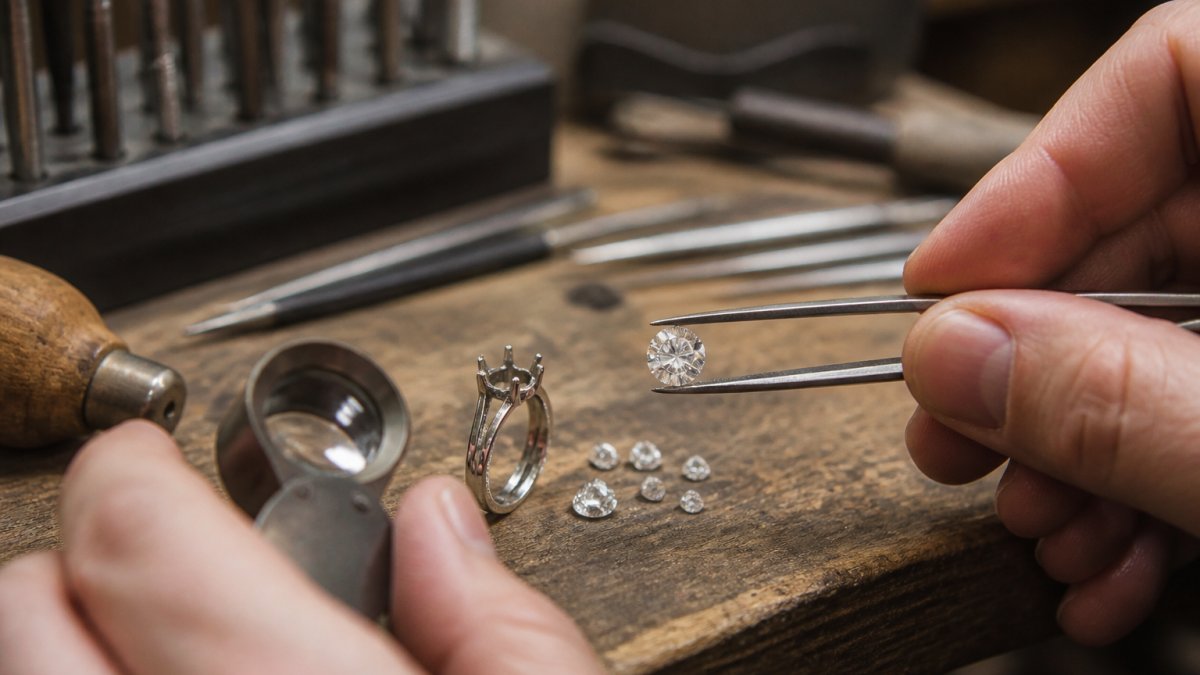
Start with cut, because it drives sparkle more than any other factor: a well-cut stone in a slightly lower color grade outperforms a poorly cut stone every time.
Before you commit, read the Gemological Institute of America's diamond grading overview so you understand what the report is actually telling you.
Matching Stone Shape to Setting Style
Shape and setting have to agree, or the piece fights itself. Pairings that work:
- Round brilliant in a solitaire: the safest, most timeless combination, and the easiest to resize later.
- Oval or pear in a halo: the halo amplifies the elongated shape instead of crowding it.
- Emerald or asscher in a bezel: step cuts suit clean, protected settings and show fewer inclusions.
A common mistake is an intricate setting for a stone with a delicate girdle: pave and prong work can leave thin edges exposed. If the design is heavy on detail, favor a sturdier cut.
Budgeting a Complete Custom Piece
Budgeting a complete custom piece means splitting your total across four lines: center stone, setting and metal, labor and design, and finishing. Most buyers fixate on the stone and forget the rest, then get surprised by the total. Build the budget in the order a jeweler builds the piece: setting first, stone second, labor and finishing last.
For a typical custom ring in a precious metal, the center stone is often the largest single line, but the share swings widely with stone size and design complexity. A simple solitaire might put 50-60% of the budget into the stone; a detailed halo or three-stone design can drop that to 35-45% because setting and labor grow. Use these ranges as a starting point, not a quote:
| Budget Line | Typical Share of Total | What It Covers |
|---|---|---|
| Center stone | 35-60% | The lab-grown diamond itself, priced by carat, cut, color, and clarity |
| Setting and metal | 20-35% | Band, prongs, halo, metal type and weight |
| Labor and design | 15-25% | CAD modeling, casting, stone setting, bench work |
| Finishing and engraving | 3-8% | Polishing, engraving, final quality check |
For example, on a $4,000 total budget, a reasonable split might be $2,000 for the center stone, $1,000 for the setting and metal, $800 for labor and design, and $200 for finishing. Readers weighing cost can find a full breakdown of whether custom jewelry is worth the price.
A step-by-step budget workflow keeps the numbers honest:
- Set your total ceiling first. Decide the most you will spend, including tax and shipping. Custom work is hard to undo, so the ceiling should be firm.
- Price the setting before the stone. Metal choice and design complexity are the most predictable costs. Knowing the setting line tells you what is left for the stone.
- Allocate the stone budget by priority. If size matters most, accept a slightly lower color or clarity grade. If sparkle matters most, protect the cut grade and adjust carat.
- Reserve 10% for finishing and contingency. Engraving, sizing, and small design changes add up. A reserve prevents a mid-project surprise.
- Get the quote in writing with line items. Ask the jeweler to break out stone, metal, labor, and finishing so you can see where the money goes.
Two ways to protect the budget: choose the setting before the stone so you know the metal cost upfront, and leave room for resizing. A ring sized too tight will cost more to fix than to size correctly the first time. Also ask whether the quoted labor includes setting the stone and final polishing, or whether those are separate charges.
Pricing depends on stone specs, metal choice, design complexity, and delivery timeline, so we quote each piece individually rather than publish fixed figures.
Certification, Disclosure, and Aftercare for Custom Orders
Certification, disclosure, and aftercare decide whether a custom order ages well. Insist on a grading report from a recognized lab, confirm the stone's origin is disclosed in writing, and ask what the maker covers after delivery. The details matter more for custom work because the stone is set into a piece built around it, and reversing that decision is expensive.
What a Grading Report Should Tell You
A grading report from a recognized lab, such as the Gemological Institute of America (GIA) or the American Gem Society (AGS) Laboratories, documents the stone's 4Cs and, for lab-grown diamonds, its growth method. Check that the report matches the delivered stone on these points:
- Measurements. The report lists the stone's dimensions in millimeters. Confirm they match the stone in your piece, especially if the setting hides part of the girdle.
- Carat weight. The report weight should match the invoice. A difference of a few hundredths of a carat can be normal, but a larger gap deserves a question.
- Color and clarity grades. These should match what you agreed to in the design conversation.
If the report is from a lab other than GIA or AGS, ask how its grading compares. Some labs grade more generously than others, and a custom order is not the place to discover that after the fact.
Disclosure in Writing
The invoice and any appraisal should state clearly that the diamond is lab-grown, which protects you if the piece is ever insured, appraised, or resold. Ask for the disclosure in the product description, the invoice, and the appraisal document, not just verbally. If you are buying online, review the return policy so you know where you stand on personalized pieces. Guidance on buying custom jewelry online safely covers certification and aftercare for remote orders.
Aftercare and Service Questions to Ask Before Ordering
Aftercare is where custom pieces differ from off-the-shelf jewelry. Ask three questions before ordering:
- Can the piece be resized, and within what range? A full-eternity band or a channel-set design may have little or no resizing room. Ask before the metal is cut.
- What repairs are covered, and for how long? Prong tightening, rhodium replating on white gold, and stone replacement are common needs. Know which are included and which are billed.
- How should the stone and setting be cleaned? Most jewelers recommend warm water, mild dish soap, and a soft brush for routine cleaning, with ultrasonic cleaning only if the jeweler confirms the setting is secure. Avoid harsh chemicals and store the piece separately to prevent scratches.
A simple maintenance schedule helps: clean monthly, have prongs checked every six to twelve months, and get a professional inspection annually. Keep the grading report and invoice with the piece so service and insurance claims are straightforward.
Watch out: skipping the written disclosure or accepting a report that lists different measurements than the delivered stone are the two mistakes that cause the most disputes after a custom order.
Start Your Custom Design with Lynrix
A custom piece built around a lab-grown diamond gives you more design for the money, documented origin, and a stone that behaves exactly like a mined one.
At Lynrix.com, we build personalized jewelry around exactly that process. Our collection includes custom jewelry and engraved pieces for anniversaries, birthdays, and milestones, with personalization options that make the gift specific to the recipient.
Get started with Lynrix.com and turn your design idea into a finished piece made for the moment you have in mind.
Frequently Asked Questions
Are lab grown diamonds a good choice for custom jewelry?
Yes. Lab grown diamonds are chemically, physically, and optically identical to mined diamonds, so they cut, set, and engrave the same way. For custom jewelry they offer two practical advantages: more of your budget goes toward size and design rather than the stone itself, and you can specify exact characteristics like cut, color, and clarity more precisely. Ask for a grading report with every stone and confirm the setting is built for the shape you choose.
How do lab-grown diamonds hold their value compared with natural diamonds?
Lab-grown stones typically resell for far less than their purchase price because production costs keep falling and supply is growing. Natural diamonds also lose value on resale, but usually less sharply. Treat a lab-grown diamond as a piece you buy to wear and enjoy, not as an investment. If resale matters to you, ask about buyback policies before ordering and weigh that against the savings on the initial purchase.
Can a jeweler tell if a diamond is lab grown or natural?
A trained gemologist using laboratory equipment can usually identify a lab-grown diamond. Standard magnification alone is not reliable because the two are structurally identical. Most lab-grown stones carry a grading report from a lab that states the growth method, and disclosure of origin is required when selling. Always request the report and keep it with your purchase records for insurance and future servicing.
How should I choose a lab-grown diamond for a custom setting?
Start with the setting, then pick the stone. A bezel setting protects the girdle and suits everyday wear, while prongs show more of the stone and need periodic tightening. Match shape to the design: ovals and emeralds elongate the finger, rounds are the most forgiving on clarity. Prioritize cut grade first, then color and clarity, and set a carat target last so the budget stays flexible.


