


Last Updated: October 29, 2026
Quick Summary
To select high quality ceramic mugs, start with the clay body: choose high-fired stoneware or porcelain with a glossy, fully sealed glaze, a rounded rim, and a handle that fits your grip. Verify food safety by asking the seller for finished-mug lead and cadmium test results, then inspect for crazing, bare patches, and a smooth rim.
- Stoneware is dense and tough, porcelain is fine-grained, and earthenware is softer and more porous.
- A dull thud on the tap test can mean a hidden crack, so return the mug.
- Warm the mug with tap water before pouring boiling liquid to prevent thermal shock.
- Match capacity to drink: 6-8 oz for espresso, 11 oz for standard coffee, 15 oz for large coffee.
- The I'm a Proud Dad and Adventure ceramic mugs are $14.99 in 11 and 15 oz.
Table of Contents
- Start With the Clay: Stoneware vs Ceramic Mugs and Other Materials
- How to Tell if a Ceramic Mug Is Food Safe
- The 8-Point Inspection Checklist for Ceramic Mugs
- Glaze, Firing Temperature, and What They Say About Durability
- Microwave-Safe Ceramic Mugs: How to Confirm Before You Buy
- Rim, Handle, Weight, and Capacity: The Comfort Details
- The Best Ceramic Mugs for Coffee and How to Match Mug to Use
- Care, Thermal Shock, and Making a Good Mug Last
- Frequently Asked Questions
Start With the Clay: Stoneware vs Ceramic Mugs and Other Materials
Learning how to select high quality ceramic mugs starts with the clay body, because the material decides how a mug handles heat, wear, and daily use. The clay is worth examining first whenever you assess drinkware. Ceramic is the broad family name for fired clay, and the specific type underneath matters more than any label on the box.
- Stoneware is dense, heavy, and tough. It shrugs off chips and holds heat well.
- Porcelain is fine-grained, smooth, and often white through and through.
- Earthenware is softer and more porous. It needs a good glaze to work as a daily mug.
Most mugs sold for everyday coffee are stoneware or porcelain. Both can be excellent. Neither is automatically better.
Porcelain, Bone China, and Earthenware in Plain Terms
Porcelain is a high-fired clay made from kaolin. It fires dense and glassy, so it resists water absorption and stains.
Bone china is porcelain with bone ash added. It fires translucent and very white.
Earthenware fires at lower temperatures. It stays porous, so a quality earthenware mug needs a fully sealed glaze.
A common mistake is assuming "ceramic" means one thing.
How to Tell if a Ceramic Mug Is Food Safe
A ceramic mug is food safe when its glaze is fully fired, free of leachable lead and cadmium in the food-contact layer, and intact with no cracks or worn patches. The hard part is verifying that before you buy.
The United States Food and Drug Administration sets limits on how much lead and cadmium may leach from ceramic foodware, and imported and domestic mugs alike must meet those limits. You can read the FDA guidance on ceramic foodware and lead for the official rules.
What a Lead-Free or Cadmium-Free Claim Should Actually Mean
A "lead-free" label should mean the glaze and decoration contain no added lead. "Cadmium-free" works the same way for the pigments that make reds, oranges, and yellows.
Some makers test finished mugs, not just the clay and glaze they start with. Ask one plain question: "Do you have test results for the finished mug?" A seller who has them will share them.
How to Verify Food-Contact Safety Claims
You do not need a lab to separate a real claim from a sticker. Work through these checks in order:
- Look for a named standard, not just a slogan. A claim that cites a recognized testing framework is stronger than a bare "100% safe" badge. The NSF International standards for food equipment materials are a useful reference for how food-contact materials are evaluated.
- Ask for the test report, not the marketing copy. A finished-mug leach test report will name the mug or SKU, the date, and the limits tested against. A screenshot of a certificate with no product name is not verification.
- Check the inside glaze, not the outside. Decoration on the exterior is low risk. Paint, metallic trim, or a decal inside the cup where it meets liquid is the part that matters.
What to Ask a Seller Before You Buy
A short script covers most of it: What type of clay is the body? Is the interior glaze fully sealed with no bare clay? Was the finished mug tested for lead and cadmium leaching, and can you share the report? Is the decoration inside the cup or only outside? Is the mug stated as microwave and dishwasher safe? A seller who answers all five clearly is usually selling a mug that will pass the physical inspection too.
The 8-Point Inspection Checklist for Ceramic Mugs
You can grade a mug in about a minute with this checklist. Use it in a store or on the mug you already own.
- Base ring: unglazed foot ring sits flat, no wobble on the counter
- Rim: smooth and rounded, no rough edge or nick
- Inside glaze: fully covered, even, no bare patches
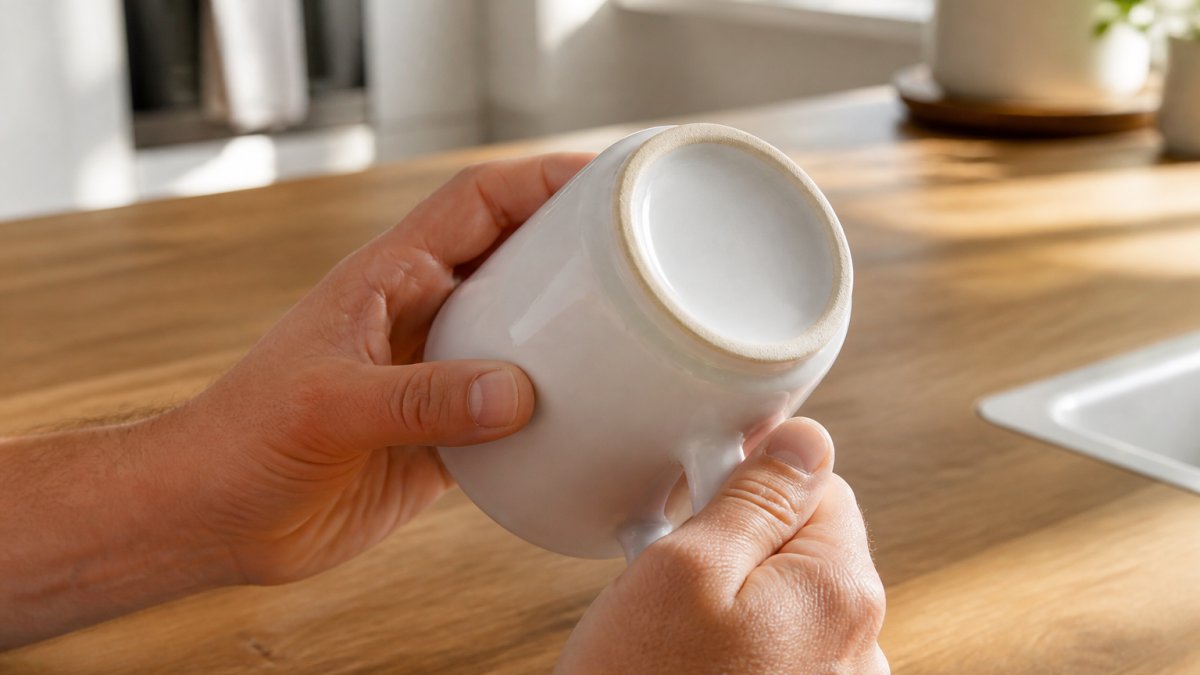
A dull thud on the tap test can mean a hidden crack. That is a defect, not a quirk. Return it.
Glaze, Firing Temperature, and What They Say About Durability
Glaze quality and firing temperature decide how long a mug survives real life.
Firing temperature is the heat the clay reaches in the kiln.
Porosity is how much water a clay body can soak up.
Stain resistance comes from a smooth, sealed glaze.
Chip resistance depends on wall thickness and how the rim is finished.
What most guides miss is that a beautiful glaze can hide a weak body.
Microwave-Safe Ceramic Mugs: How to Confirm Before You Buy
A ceramic mug is microwave safe when it carries no metallic decoration and the maker states it is microwave safe.
Confirm it in three steps:
I'm a Proud Dad – Ceramic Mug →
- Check the base or tag for a microwave safe mark.
- Look for metallic paint anywhere on the mug, inside or out.
- If unsure, heat a cup of water in it for 30 seconds and feel the mug body. If the mug itself gets very hot while the water stays cool, it is absorbing energy and is not microwave safe.
Stoneware and porcelain are generally fine when undecorated with metal. Earthenware is the one to question, because a porous body can trap moisture that heats unevenly. For the FDA's stance on cookware claims, see the FDA cookware and microwave safety information.
Thermal Shock: The Most Common Way Good Mugs Die
Thermal shock is the fast temperature change that cracks ceramic, and it is the leading killer of otherwise good mugs.
Protect your mugs with a few habits:
- Warm the mug with tap water before pouring boiling liquid
- Let mugs cool before rinsing them in cold water
- Skip the freezer for chilling a mug, then filling it hot
A mug that has already crazed is far more vulnerable to thermal shock, because the fine cracks give heat and moisture a path into the body. Once crazing starts, treat the mug as hand-wash only and avoid sudden temperature swings.
Dishwasher Use and Long-Term Maintenance
Dishwasher-safe mugs tolerate machine washing, but repeated heat cycles can wear on decoration over time. Hand washing extends the print and the glaze. A few habits keep a good mug in rotation for years:
- Rinse promptly. Coffee and tea acids stain a matte or worn glaze faster than a glossy one; a quick rinse before the residue dries does most of the work.
- Skip abrasive scrubbers on decorated surfaces. A soft sponge protects the print; steel wool and harsh cleansers dull the glaze.
- Soak stains, don't scrape them. A paste of baking soda and water lifts coffee stain from a sealed glaze without scratching it.
Rim, Handle, Weight, and Capacity: The Comfort Details
Comfort is where cheap mugs give themselves away.
Rim shape: a rounded rim feels soft on the lip.
Handle size and shape: you should fit two fingers through it comfortably. A handle that is too small forces a pinch grip. Too large and the mug tips forward.
Weight and balance: an empty mug should feel steady, not top-heavy. A heavy base adds stability on the counter.
Capacity: match the mug to the drink.
- 6-8 oz: espresso and cortado
- 11 oz: standard coffee or tea
- 15 oz: large coffee, cocoa, or soup
Ergonomics matter more than style.
Match the mug size to the drink so the cup feels right in hand and on the counter.
| Capacity | Best for |
|---|---|
| 6-8 oz | Espresso and cortado |
| 11 oz | Standard coffee or tea |
| 15 oz | Large coffee, cocoa, or soup |
The Best Ceramic Mugs for Coffee and How to Match Mug to Use
When choosing ceramic mugs for coffee, look for high-fired stoneware or porcelain with a glossy, fully sealed glaze, a rounded rim, and a handle that fits your grip. Match the mug to the job and you will rarely go wrong.
Here is how we match mug to use:
- Daily coffee at a desk: 11 oz stoneware, thick walls, wide handle
- Espresso: 6 oz porcelain, thin wall, small handle
- Long weekend brew: 15 oz stoneware with a heavy base
We also offer the I'm a Proud Dad ceramic mug and Adventure ceramic mug, both $14.99 in 11 and 15 oz, with a white gloss finish, dishwasher-safe and microwave-safe build. The Great Things Are Coming mug is a ceramic mug option, and the Dreams Never Die 11 oz mug is available in 11 oz.


Care, Thermal Shock, and Making a Good Mug Last
Protect your mugs with a few habits:
- Warm the mug with tap water before pouring boiling liquid
- Let mugs cool before rinsing them in cold water
- Skip the freezer for chilling a mug, then filling it hot
If you are buying a mug as a gift, our gift wrap with a personalized message option lets you add a note before checkout. A good mug plus a written message is a gift that gets used, not stored.
The NSF International standards for food equipment materials are a useful reference if you want to check how food-contact materials are tested.
Frequently Asked Questions
How can you tell if a ceramic mug is high quality?
Check four things. Tap the rim: a clear ring means no hidden cracks, a dull thud means a flaw. Look at the base for an unglazed foot ring that sits flat without wobbling. Run a finger around the rim and handle for rough patches or sharp seams. Finally, confirm the glaze is even with no pinholes, crawling, or bare clay spots near the lip. A mug that passes all four is built to last through daily use.
What is the difference between stoneware and ceramic mugs?
Ceramic is the umbrella term for fired clay, and stoneware is one type within it. Stoneware is fired at higher temperatures, which makes it denser, heavier, and more chip-resistant than earthenware. Porcelain is finer and lighter still. In practice, stoneware vs ceramic mugs usually comes down to weight and feel: stoneware holds heat well and takes knocks, while thinner porcelain feels more delicate but suits espresso and tea service.
Can I pour boiling water into a ceramic mug?
Yes, if the mug is high-fired stoneware or porcelain and at room temperature. Thermal shock happens when the temperature gap is large, such as pouring boiling water into a mug straight from a cold cabinet or a chilly garage. Warm the mug with tap water first, then add the hot liquid. Never place a cold mug directly onto a hot stove or into a preheated oven unless the maker explicitly rates it for that use.
How do I know if a ceramic mug is microwave- and dishwasher-safe?
Look for the words on the base or the product listing, not just a symbol you think you recognize. Metallic decals, gold rims, and hand-painted accents often rule out microwave use even when the body is safe. For dishwasher safety, check whether the decoration sits under the glaze rather than on top of it. If the listing is silent on both, hand wash and reheat in a separate container to protect the finish.
Most mugs fail not because they were cheap, but because nobody checked the clay, the glaze, or the rim before buying. That is a fixable problem. At Lynrix.com, we build our ceramic mugs around a white gloss finish, a comfortable handle, and 11 and 15 oz sizes that suit real daily use, all at $14.99. Add a personalized message at checkout and give a mug someone will actually reach for. Get started with Lynrix.com and pick a mug that lasts past the first hundred coffees.


