


Last Updated: October 29, 2026
Quick Summary
To personalize jewelry with actual handwriting, scan or photograph the handwritten note at 300 to 600 dpi, crop tight to the words, and send the clean image to an engraver who reproduces it with laser or hand engraving. Knowing how to personalize jewelry with actual handwriting starts with a sharp, straight-on sample, since the image quality decides how good the final engraving looks.
- Scan handwriting at 300 dpi minimum, or 600 dpi for small or fine writing.
- Shoot photos straight down in bright, even light and never use flash.
- Avoid redrawing letters during cleanup, because the wobble is the handwriting's character.
- Laser engraving suits fine handwriting, while hand engraving suits bold signatures.
- Clean engraved pieces with warm water, mild soap, and a soft cloth.
Table of Contents
- What Handwriting Jewelry Is and Why It Outlasts a Font
- How to Scan Handwriting for Engraving: Photo and Scan Specs That Work
- Step-by-Step: From Paper Sample to Finished Piece
- Choosing the Right Piece: Handwriting Jewelry Design Ideas
- Engraving Methods and Which Metals They Work On
- Proofs, Turnaround, and What Can Go Wrong
- Handwriting Jewelry Care: Keeping the Engraving Legible
- Ordering Your Handwriting Keepsake From Lynrix.com
- Frequently Asked Questions
What Handwriting Jewelry Is and Why It Outlasts a Font
Handwriting jewelry is custom jewelry engraved with a real handwritten message, signature, or note rather than a typed font.
That difference matters more than most people expect. A font is a design choice anyone can copy. Actual handwriting is proof of a person.
For anyone comparing engraved heirloom jewelry vs mass-produced pieces, the contrast is stark: one is a sentimental gift with a person behind it, the other is inventory.
How to Scan Handwriting for Engraving: Photo and Scan Specs That Work
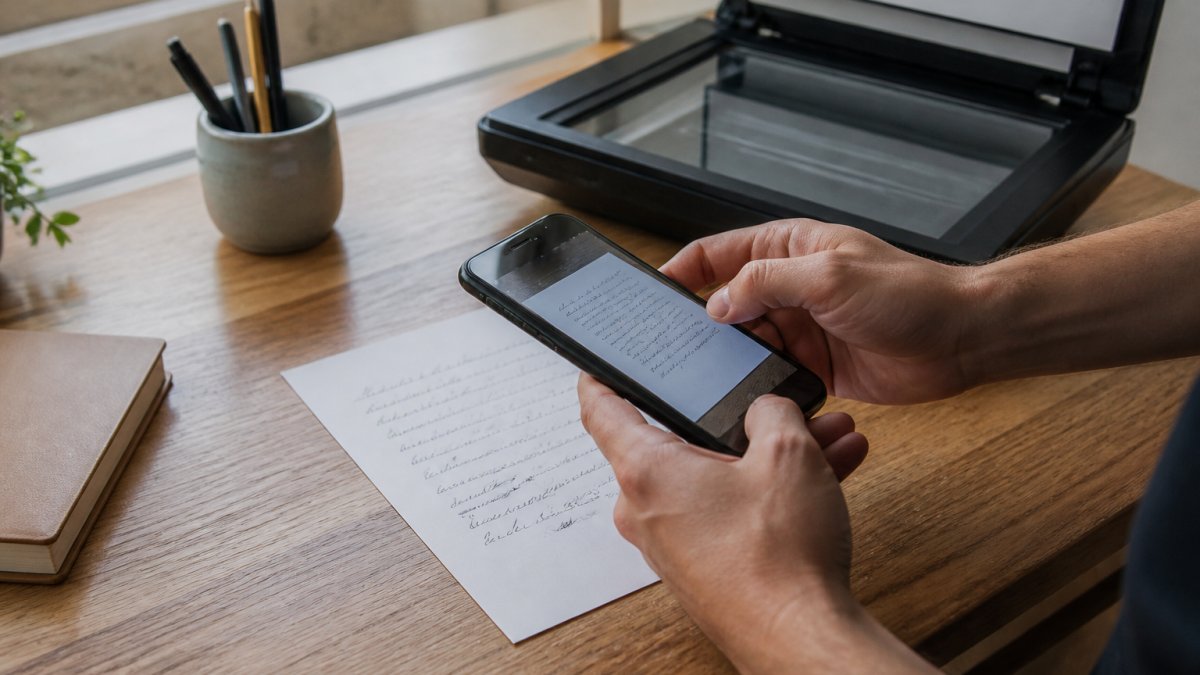
Getting a clean image is the step that decides how good the final engraving looks. A flatbed scanner at 300 to 600 dpi gives the most reliable result.
Here is what works:
- Resolution: 300 dpi minimum for scans; 600 dpi if the writing is small or the strokes are fine. A modern phone camera at 12 megapixels or higher is usually enough, but check that the letters are sharp at full zoom before you send it.
- Format: PNG or high-quality JPG. Avoid screenshots of screenshots, HEIC files that some engravers cannot open, and heavily compressed images that blur stroke edges.
- Color: scan in grayscale or convert to grayscale before sending. Color adds no engraving value and can hide faint pencil strokes.
Getting a Clean Image: Lighting, Crop, and Cleanup
Avoid overhead lamps that cast shadows across the page, and never use flash. Indirect daylight from a window, or two lamps placed at 45-degree angles to the page, gives even illumination without hotspots.
Crop tight to the words you want engraved, then check that every letter is legible at full zoom. For a deeper walkthrough, see our professional jewelry engraving step-by-step guide.
Handling Faded, Small, or Awkward Samples
Not every sample is a crisp ballpoint signature on white paper. Here is how to handle the common problem cases:
- Faded pencil or light ink: increase contrast in a basic photo editor, but stop before the strokes break up. If the line disappears at 100% zoom, it is too faint to engrave cleanly.
- Very small writing: scan at 600 dpi rather than 300. Small handwriting loses detail fast, and the engraver needs every stroke edge to reproduce it.
- Writing on lined or patterned paper: remove the lines digitally if you can do so without touching the letters. If not, tell the engraver which marks are background and which are the writing.
A practical rule: if you can read every letter on your phone screen without zooming, the engraver can probably work with it. If you have to squint, rescan or reshoot before you order.
Step-by-Step: From Paper Sample to Finished Piece
The full workflow takes five steps. Most delays happen at the sample stage, not the engraving stage, so get the writing right first.
- Collect the original writing. Ask for a handwritten card, recipe, or signed note. A birthday card or letter works better than a rushed signature.
- Choose the words. Pick a short phrase, a name, or a signature. Fewer words mean larger, clearer engraving.
- Scan or photograph it. Follow the specs above and keep the original safe.
- Clean up the image. Remove background lines and stray marks, but never redraw the letters. The wobble is the point.
Watch out: the most common mistake is sending a photo taken at an angle. The engraver has to guess the proportions, and the final piece looks off. Shoot straight down.
Choosing the Right Piece: Handwriting Jewelry Design Ideas
The best piece depends on how often it will be worn and how much writing you want to show. A short signature suits a small charm. A full phrase needs a wider pendant or a bracelet plate.
Popular handwriting jewelry design ideas include: what to look for in personalized jewelry.
- A signature on a thin bar necklace
- A short note on a cuff bracelet
- A name in a parent's handwriting on a ring band
Why a Handwriting Engraved Necklace Is the Most Popular Choice
A handwriting engraved necklace wins on visibility and daily wear. It sits close to the heart, shows the writing clearly, and layers well with other pieces. Stacking bracelets are a close second, but a pendant gives the handwriting more room to breathe.
Engraving Methods and Which Metals They Work On
Laser engraving is the most common method for handwriting because it reproduces fine pen strokes with high accuracy. Hand engraving suits simpler signatures and softer metals. The metal you choose affects how sharp the lines look.
| Method | Best For | Works Well On |
|---|---|---|
| Laser engraving | Fine handwriting, small text | Sterling silver, gold, stainless steel |
| Hand engraving | Signatures, bold strokes | Gold, silver, copper |
| Diamond drag | Crisp thin lines | Stainless steel, plated metals |
Softer metals like sterling silver take detail beautifully but scratch more easily. Harder metals hold up to daily wear but can blur very fine strokes. Tell your engraver which matters more to you.
How Each Method Changes the Look of Handwriting
The method matters as much as the sample. Each one leaves a different mark on the metal, and that mark changes how close the finished piece feels to the original pen stroke.
- Laser engraving removes or fuses a thin layer of metal, producing a dark, high-contrast line. It handles tight loops and small text well, which is why it is the default for handwriting pendants and bar necklaces. On polished gold and silver, the contrast is crisp; on matte or brushed finishes, the line can look softer.
- Hand engraving uses a graver to cut a V-shaped groove. The line catches light differently from a laser line and reads as more traditional and dimensional. It suits bold signatures and short phrases, but very fine pencil strokes are hard to cut cleanly by hand.
- Diamond drag engraving scratches a shallow line with a diamond tip. It is fast and affordable and works well on stainless steel and plated metals, but the line is shallow and can wear down on pieces that see heavy daily contact.
Metal and Finish Compatibility
The same handwriting can look sharp on one metal and muddy on another. A few practical patterns:
- Sterling silver takes fine detail well and is the most common choice for handwriting jewelry. It is soft enough to engrave cleanly but scratches with daily wear, so a polished finish shows marks sooner than a brushed one.
- Yellow and white gold hold detail well and resist tarnish better than silver. White gold rhodium plating can make laser lines look slightly cooler in tone; yellow gold warms them up.
- Stainless steel is durable and affordable, and it suits diamond drag and laser engraving. Very fine handwriting can lose some crispness because the metal is harder and the line is shallower.
Finish matters too. A high-polish surface reflects light and can make thin engraved lines harder to read at a glance. A brushed or matte finish scatters light and often makes handwriting more legible, especially on small pendants.
Matching the Method to the Piece
A short signature on a small charm and a full phrase on a wide cuff bracelet are different engraving problems. As a rule of thumb:
- Small charms and rings: laser engraving, because the writing area is tight and fine detail matters.
- Bar necklaces and pendants: laser engraving for fine writing, hand engraving for bold signatures.
- Cuff bracelets and wide plates: hand engraving can work well because there is room for a deeper, more dimensional line.
- Stainless steel gifts: laser or diamond drag, depending on whether you want contrast or a lighter scratch line.
Proofs, Turnaround, and What Can Go Wrong
What can go wrong:
- A faint sample produces a faint engraving
- Too much cleanup erases the writer's character
- A rushed order skips proof approval
- Very small text loses legibility on curved surfaces
Set realistic expectations: a scan of a pencil note will never look as crisp as a bold pen signature. That is normal, not a defect.
Handwriting Jewelry Care: Keeping the Engraving Legible
Handwriting jewelry care is mostly about protecting the engraved lines from buildup. Warm water, a drop of mild soap, and a soft cloth keep the strokes readable. For detailed steps, see our guide to clean sterling silver keepsake jewelry at home. Avoid abrasive polishes, which can wear down fine detail over time.
A few habits protect the piece:
- Put jewelry on last, after lotion and perfume
- Remove it before swimming or showering
- Store it dry, away from other pieces
- Wipe it after each wear
Ordering Your Handwriting Keepsake From Lynrix.com
At Lynrix.com, we offer a curated selection of personalized gifts and lifestyle products designed to celebrate special connections.
- Personalized gift options for anniversaries, graduations, and milestones
- A range of jewelry and lifestyle products, including a signature style name necklace
Frequently Asked Questions
How do you put someone's actual handwriting on jewelry?
You start with an original handwritten note, card, or signature, then capture it as a high-resolution photo or scan. The image is cropped and cleaned up so the strokes read clearly, and the jeweler converts it into an engraving file. That file is then engraved onto the metal surface by laser or hand. The key is a clean source image: a sharp, evenly lit scan preserves the loops, pressure changes, and slant that make handwriting jewelry feel personal rather than typed.
What kind of handwriting sample works best for engraving?
Dark ink on plain white or light paper gives the cleanest result. Ballpoint, rollerball, and fine-tip marker all work well; pencil and light gel pens tend to scan faintly. Avoid lined paper, sticky notes with adhesive edges, and anything with heavy folds or creases. A short phrase of four to eight words fits most pendants and bracelets, so pick a sample with enough space between letters. If the original is precious, scan it rather than mailing it.
Can you engrave handwriting from a photo or scanned note?
Yes. A phone photo works if it is sharp, evenly lit, and taken straight on with no glare or shadow across the writing. A flatbed scan at 300 dpi or higher is more reliable because it captures fine strokes without distortion. Either way, check the image at full size before submitting: if the letter edges look fuzzy on your screen, they will look fuzzy engraved. Crop tight to the writing and keep the file in its original resolution.
How do you care for jewelry engraved with handwriting?
Keep engraved pieces away from chlorine, perfume, and household cleaners, and remove them before swimming or showering. Wipe with a soft dry cloth after wear, and use a jeweler's polishing cloth on the metal around the engraving rather than scrubbing the lettering itself. Store pieces separately in a pouch or lined box to prevent scratches. Laser engraving holds up well to daily wear; hand engraving may need occasional inspection by a jeweler if the lines start to soften.
The hardest part of handwriting jewelry is not the engraving. It is getting a clean sample and trusting the process. Lynrix.com makes that easier with personalized gift options, a curated range of jewelry and lifestyle products, and a proof approval step before production. Get started with Lynrix.com and turn a handwritten note into something she can wear every day.


